Gay Men's Social Network: NYC's Curated Lofts & Clubs
You already know the feeling. It's late, you're on your phone in Manhattan, and you're scrolling a grid of faces that look available, but not necessarily reachable. That's the problem with most of these spaces. It isn't just whether a man is cute or nearby, it's who can see you, what they learn about you, and whether the room you're in asks for trust before it asks for access.
A gay men's social network isn't one thing anymore. It can be a public group, an app, a private chat, a fitness circle, or a small room with a guest list and someone at the door who knows the names on it. If you care about discretion, the question isn't “where are the men,” it's “what kind of visibility do I want to trade for connection?” A useful way to think about that trade is through passwordless guest access, because the core issue in any network is still the same, who gets in, what they see, and how much friction protects the right people without making the whole thing feel dead.
Table of Contents
- What a Gay Men's Social Network Actually Looks Like in 2026
- Defining the Three Main Formats Men Use Today
- Online Versus In-Person and Invite-Only Compared
- Why Smaller Curated Rooms Address What Apps Cannot
- How a Private Loft Night Like BAREHOUSE Is Built
- Consent Etiquette and House Rules That Hold the Room
- Finding and Vetting a Discreet Community in NYC
What a Gay Men's Social Network Actually Looks Like in 2026
A man in Manhattan usually is not looking for “a network.” He wants a place to talk, flirt, meet, or show up without giving away his whole life to strangers. That is the test. A gay men's social network works only if it tells you who can see you, what they can infer, and how much trust is built into the room before anyone says hello.
The smart way to read these spaces is through visibility-and-trust, because chemistry alone does not solve discretion. You can like a man and still not want his friends, his camera roll, or his screenshots tied to your name. The question is not how many people are around. It is what kind of access they get, and what they can do with it.
A space that cannot explain privacy is built for exposure, not discretion.
Open platforms help people find names, events, and activity across a city. Anonymous apps give fast contact and little memory. Small rooms, including invite-only lofts, are where trust starts to matter as much as access. That is also where passwordless guest access makes sense in practice, because the point is to let the right men in without turning the door into a spectacle. In a place like BAREHOUSE, the rules, the guest list, and the tone all work together. The room stays controlled, the entry stays discreet, and the social pressure shifts from proving yourself online to showing up with the right expectations.
That is the difference men feel immediately. Public spaces chase reach. Apps chase speed. Curated rooms protect the social layer that makes privacy real.
Defining the Three Main Formats Men Use Today
Start with the public layer. Large open platforms, like Facebook groups, Reddit threads, and citywide forums, are built for reach. They make it easy to find events, read comments, and see what's happening across a city, but they also make your participation visible to anyone who's looking. A typical interaction there is simple, a man joins, reads a post, maybe comments once, and disappears without ever becoming a person in the room.
Open platforms, anonymous apps, and curated rooms
Anonymous app-based networks work differently. The logic is faster, narrower, and more transactional. A profile becomes a face, a distance, and a few lines, then the conversation moves toward logistics or dies in the queue. It's efficient, but it doesn't build much memory, and it usually doesn't tell you whether the other man can be trusted in a real room.
Curated in-person formats sit on the other side of that divide. They include small loft events, private clubs, moderated meetups, and screened communities where the guest list is part of the product. One typical interaction is more human from the start. A host checks you in, you enter a room with rules, and the first few minutes are spent reading the energy, not just chasing the next message.
| Model | Openness | Privacy | Vetting | Best For |
|---|---|---|---|---|
| Open platforms | High | Low | Light | Discovery, event browsing, broad visibility |
| Anonymous apps | Medium | Medium | Minimal | Fast contact, low-friction matching |
| Curated in-person rooms | Low | High | Strong | Discretion, trust, repeat attendance |
If you want a quick read on how anonymous contact often works in practice, a service that helps men get a Grindr number for SMS sits in that same world of speed and reduced friction. That's useful when you want reach, but it's still not the same as trust.
Online Versus In-Person and Invite-Only Compared
Open online networks are good at one thing, breadth. They let you see what's out there without needing an introduction, and they're useful when you're new to a city or trying to understand the scene without walking into it blind. The cost is that your presence is easy to expose, and your involvement can become visible to people you never meant to include.
Anonymous apps are good at speed. They strip away a lot of ceremony, which is why men use them when they want immediate contact, no social homework, and very little commitment. The problem is that this design also strips away accountability. A face and a location don't tell you much about character, and they definitely don't tell you who can hold a boundary.
Invite-only in-person communities are slower, but they give you something the other two formats can't. They put bodies, voices, and reputations in the same room. That changes behavior immediately because the room has memory, and memory is what makes discretion feel real instead of rhetorical.
What each model is actually good at
- Open online networks: good for finding out what exists, less good for protecting your participation from casual visibility.
- Anonymous apps: good for fast contact, less good for vetting, because the interaction starts and often ends at the profile level.
- Invite-only rooms: good for trust and repeat contact, less good for scale, because the whole point is to keep the circle limited.
For men who care about discretion, this is the decision tree. Not “which one is superior,” but “how much visibility can I tolerate before the room stops feeling safe?” If you need a place where your name, your body, and your conduct all matter together, the invite-only model is the one that behaves like a social network instead of a classifieds board.
Why Smaller Curated Rooms Address What Apps Cannot
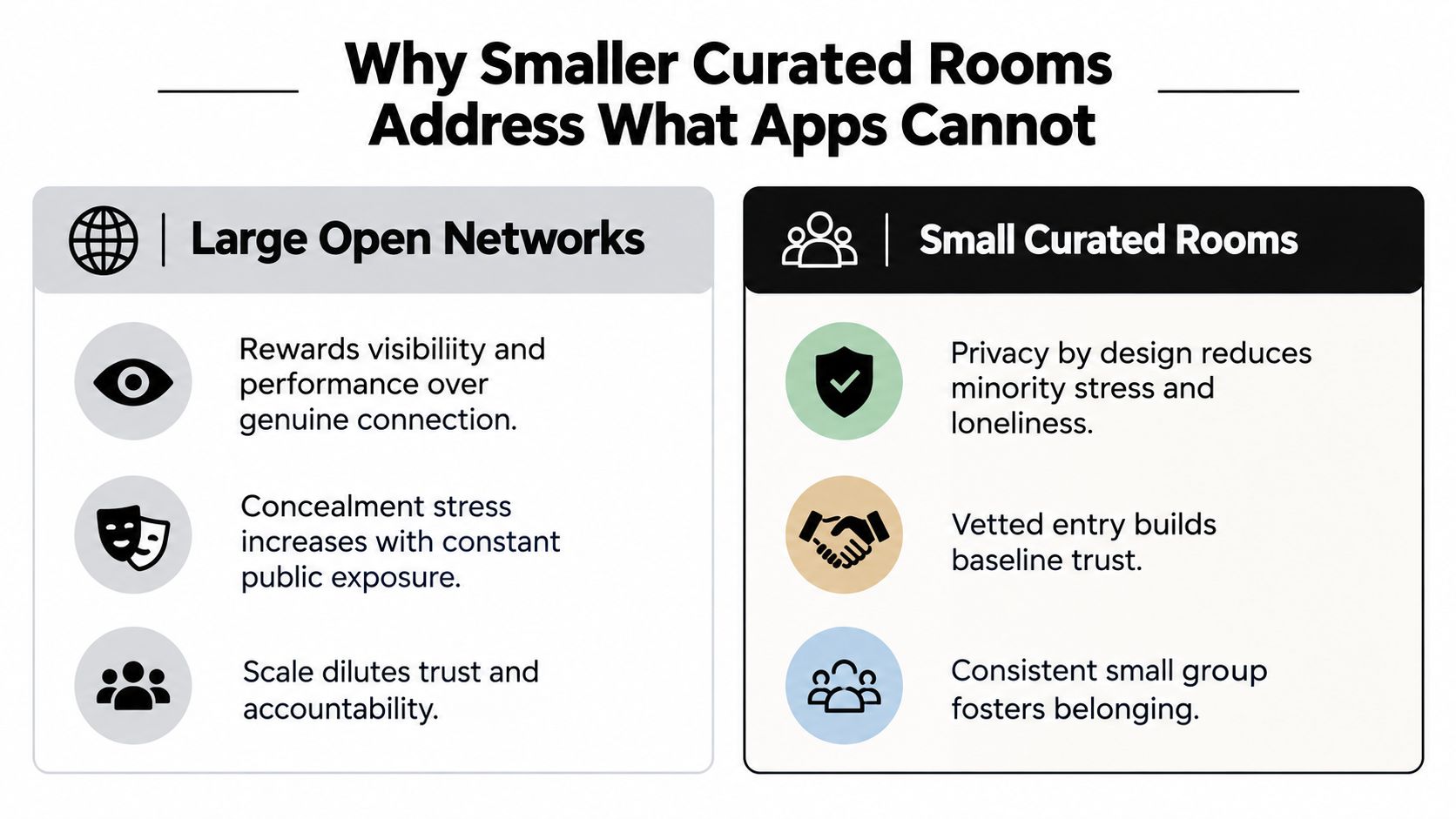
The loneliness problem is bigger than most scene chatter admits. A 2025 systematic review found gay men are particularly vulnerable to loneliness, with reported prevalence ranging from 13% to 34.7%, and it identified lack of support systems, geographic location, internalized homophobia, concealment, and fear of rejection as key drivers (systematic review). That matters because loneliness doesn't get fixed by raw exposure. It gets eased when the room lowers the social risk of being seen.
Why scale fails where trust matters
Open networks reward visibility, which can be useful when you're trying to be found and dangerous when you're trying to stay private. Anonymous apps reduce everything to contact management, which is efficient until you realize that logistics aren't intimacy. Neither model is built to carry the weight of concealment stress, or the kind of sustained trust that lets a man come back next time and not have to start from zero.
That's where small-format rooms make sense. A fixed guest list, a host who enforces rules, repeat attendance, and a room that stays small enough for people to remember each other. The social effect is simple, fewer strangers, fewer social risks, more room for baseline trust to form without forcing anyone into performance.
When the room is small, the social cost of bad behavior goes up fast. That's why these spaces can feel calmer even when the energy is sexual.
The structural logic is the same reason privacy-first design keeps showing up in good community spaces. For a practical security angle on that kind of environment, look at bespoke security design for clubs, because a room only works when the physical setup protects the rules.
How a Private Loft Night Like BAREHOUSE Is Built
BAREHOUSE presents itself as a private club for gay and bi men in New York City, and the whole setup is built around control. It uses small, curated, invite-only parties in chosen spaces, with “No walk-ins, no plus-ones” as a hard rule (about). The guest list is the gate, not a suggestion.
What the night actually depends on
The pattern is simple. Guests apply, screening happens, and the address is shared close to the event. The point is discretion, and the structure supports it.
BAREHOUSE says its nights use rotating group formats and different room moods, from slow and sensual to physical and loud/direct (experiences). That tells you the room is not locked into one social script. It can shift without turning chaotic.
Dress and phone rules do their own work. The room stays present, not performative, because guests are expected to show up with that in mind. BAREHOUSE also says consent is required in every space, and guests should watch first, read the room, ask when needed, and never enter someone's scene, pile, table, or group without being welcomed.
If you want the clearest public breakdown of the format, read the BAREHOUSE loft party guide before you go. It spells out the vibe better than a polished flyer ever will.
The key difference is scale. A small loft lets hosts notice what is happening and step in when needed, and that makes the room feel deliberate instead of loose. That is what separates a curated night from a regular social gathering with a nicer address.
Consent Etiquette and House Rules That Hold the Room
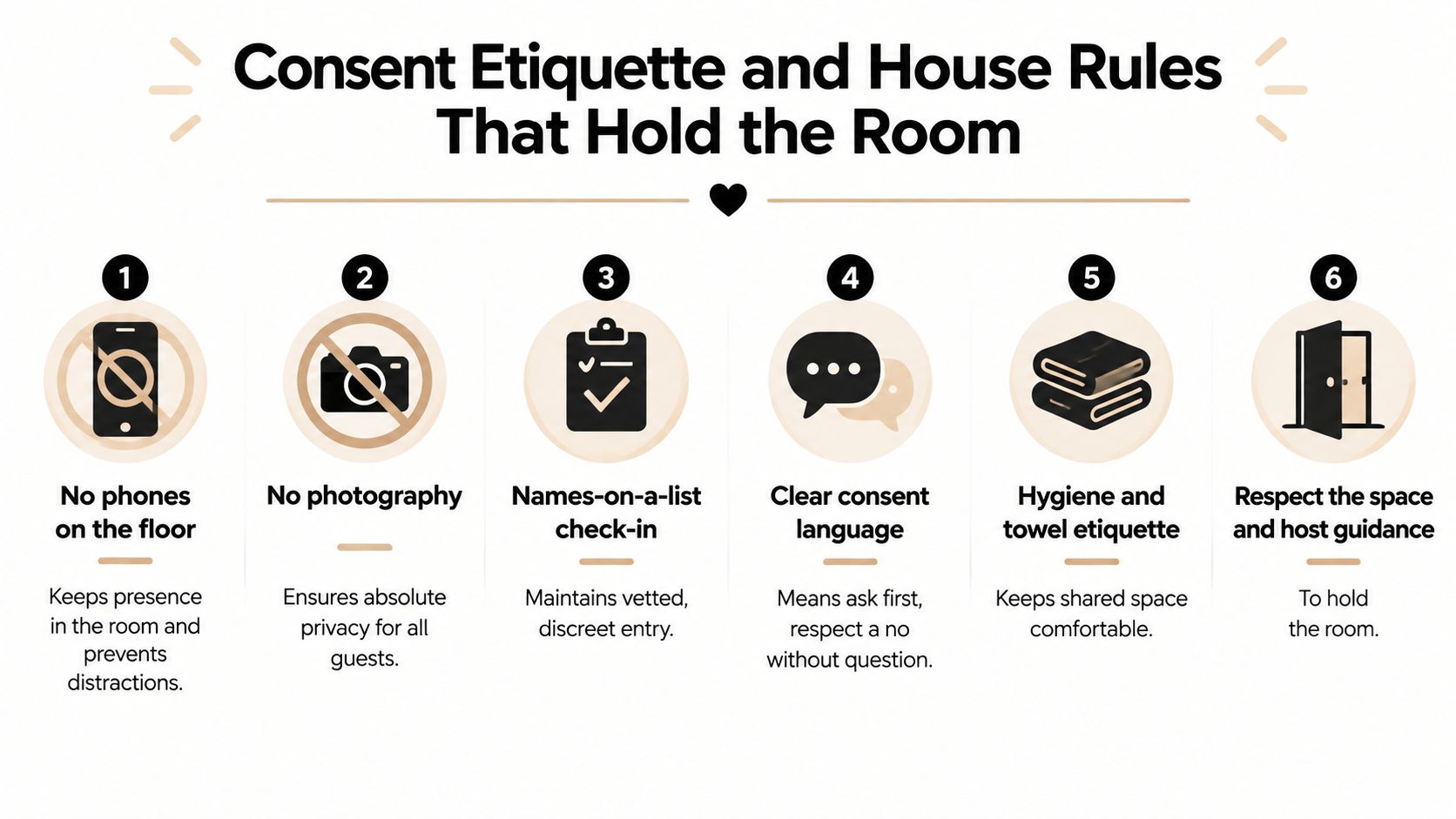
BAREHOUSE's house rules are unusually explicit, and that's why they work. Guests must ask before touching every time, “Not right now” is a complete sentence, silence or hesitation means no, and hosts are there to help if something feels off (rules). That's not extra bureaucracy, it's the frame that lets strangers relax without guessing at the rules mid-interaction.
What the rules do in practice
No phones on the floor keeps people in the room instead of half in the room. No photography protects everyone who doesn't want their night turned into someone else's memory file. A names-on-a-list check-in keeps the entry discreet and prevents the room from becoming a public funnel.
The social effect is bigger than the rule itself. When a man knows he won't be photographed, tagged, or screened by random walk-ins, he behaves differently. He stays longer, watches more carefully, and reads consent with more discipline because the room has made privacy part of the deal.
Practical rule: if you have to negotiate basic respect twice, the room has already drifted.
BAREHOUSE also publishes a separate rules page that reinforces the same logic and makes host authority clear. If you want the fuller phrasing, the club's own page on private social club rules is the one to read. In a room like this, good etiquette is not about being formal. It's about making the space feel legible enough that men don't have to protect themselves from each other all night.
Finding and Vetting a Discreet Community in NYC
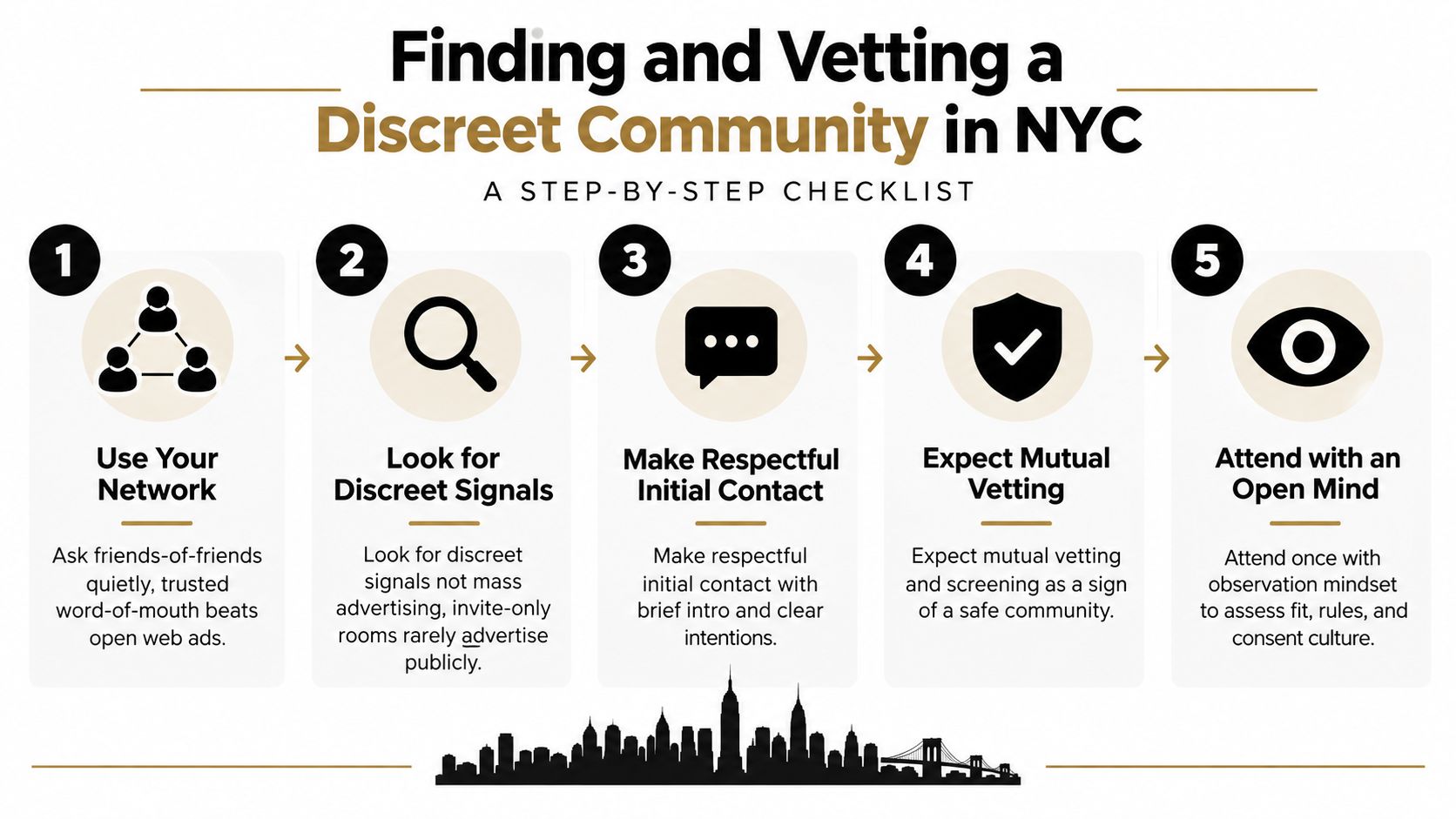
Invite-only rooms in New York usually aren't screaming for attention on the open web, and that's the right instinct. If a space is serious about privacy, it should be serious about discovery too. The cleanest entry point is still friends-of-friends, because word-of-mouth tells you more about the room's behavior than a polished landing page ever will.
What to check before you say yes
Look for a host footprint that makes sense. A clear rules page, named organizers, actual screening language, and private address sharing only after approval are all good signs. So is a consistent way of communicating, because a community that can't explain itself clearly usually can't protect itself clearly either.
Watch for red flags and leave early if they show up.
- Vague public presence: social media that hints at exclusivity but won't explain the actual process.
- Money before conversation: payment pressure before any screening or basic exchange.
- No written rules: if they won't put the floor policy in writing, they probably won't enforce it.
- Skipping vetting: any pressure to bypass screening is a warning, not a perk.
- Loose privacy language: if they can't tell you how the address, guest list, or photography are handled, don't guess.
A solid room will answer the basics without making you beg for them. Before the night, confirm the address by private message only, arrive on time, bring ID, dress to the stated code, silence your phone at the door, and have a quiet exit plan if the fit isn't right. If you want another practical reference point on how invite-only access is described, how to get invited to parties is worth a look.
If you want a private, rules-based room in New York where gay, bi, and curious men can meet without the usual noise, BAREHOUSE is built for that exact use case. It offers invite-only loft nights with screening, house rules, and a privacy-first setup that fits men who care about discretion as much as chemistry. Visit BAREHOUSE and decide whether its model matches the kind of social network you want to be part of.