Gay Event NYC: A Practical Guide to Private Loft Nights
You've searched gay event NYC and found the usual answers: Pride calendars, public festivals, bar crawls, and crowded venues. Those events can be memorable, but they don't answer a more specific question: where can an adult gay, bi, or curious man find a smaller gathering with a screened guest list, clear boundaries, and meaningful privacy outside the June rush?
That distinction matters in New York. The city's LGBTQ event culture grew from the Stonewall uprising, which began in the early hours of June 28, 1969, after a police raid on the Stonewall Inn in Greenwich Village. The unrest continued until July 3, 1969, and the first anniversary became Christopher Street Liberation Day, recognized as the first Pride march in U.S. history. Britannica's history of the Stonewall Inn places that moment at the center of the modern LGBTQ rights movement.
Public Pride remains essential. NYC Pride attendance reached 2.1 million in 2015, 2.5 million in 2016, around 2 million in 2018 and 2023, and 2.5 million in 2024, while WorldPride NYC 2019 drew an official estimate of 4 million people for the parade and about 5 million visitors across Pride weekend in Manhattan. The documented attendance history shows the scale of New York's public celebrations. But mass visibility and private connection serve different needs. A small, invite-only loft night is built for men who want to know more about the room before they enter it.
Table of Contents
- Why Private Loft Nights Are a Different Format
- What an Invite-Only NYC Men's Loft Actually Looks Like
- How Guest Screening Works Before You Get the Address
- House Rules You Follow the Moment You Walk In
- Consent Mechanics and the Role of Hosts on the Floor
- A Real Night at a Curated NYC Loft
- Evaluating Whether a Private Men's Night Is Right for You
Why Private Loft Nights Are a Different Format
Search for a gay event in NYC and you'll usually land on a citywide calendar. The options tend to be public marches, PrideFest programming, bar crawls, or large parties where the cover charge is the main filter. You arrive with limited knowledge of who else will be there, how crowded the space will feel, or how much privacy you'll have once you're inside.
A private loft night reverses that sequence. The guest list is the filter, and the door isn't open to whoever happens to find the address. The organizer reviews the people coming, shares practical information privately, and creates a room where guests can make decisions with more context.
That control comes with a trade-off. A crowd can provide anonymity. In a large venue, you can disappear into the flow, leave without explanation, or keep your distance from anyone you don't know. A smaller gathering gives up some of that anonymity in exchange for a more legible social environment. You're more likely to recognize the hosts, understand the house expectations, and notice whether the room feels right before getting involved.
Practical rule: A private format should make the guest list and operating rules clearer, not merely make the location harder to find.
The physical setting contributes to that difference. A residential-style loft feels less transactional than a commercial venue. Rooms can be arranged for conversation, socializing, or adult exploration without forcing everyone onto one shared floor. Lighting, sound, and the pace of the night can support interaction instead of competing with it.
The format also answers a gap in current search coverage. Existing NYC gay-event results emphasize major public celebrations, while smaller men-only gatherings are harder to evaluate from a search listing alone. Prospective guests often want to know the size, tone, privacy standards, consent expectations, and host presence before they request an invite. Those details are more useful than another generic list of parties.
BAREHOUSE describes itself as a private club and invite-only community for adult gay and bi men in New York City. Its model centers on small, curated events in considered spaces, with each guest reviewed before entry and no walk-ins or plus-ones. BAREHOUSE's private-club overview explains that approved members receive private invitations containing the theme, date, location, and house rules.
What an Invite-Only NYC Men's Loft Actually Looks Like
The first thing to understand is that “private loft” describes an operating format, not a single room layout. The address stays private until approval, and the space is organized around the event's purpose rather than a fixed public-venue setup.
You may enter through a host-managed check-in, surrender your phone for secure storage, and receive a concise explanation of the rules before moving into the space. From there, the room should be easy to read. Guests need to know where they can socialize, where supplies are located, how to find a host, and which areas have a different tone.
The room should explain itself
Good design reduces awkward questions. A social area gives people a place to arrive, meet others, and decide how quickly they want to participate. More private or adult-oriented areas can have clearer boundaries, while a quieter corner lets someone step away without having to leave the event altogether.
That layout matters because intimacy depends on choice. A guest shouldn't have to commit to one mood for the entire night. He may want conversation first, observe for a while, and then decide whether the event's energy suits him. A private loft works when the physical arrangement supports those changes without turning every movement into a public announcement.
The phone policy is equally important. Devices are locked on arrival, and photography isn't permitted. That prevents the event from becoming an informal content space and protects guests who are comfortable participating only when they know the room won't be documented.
Read the invite before you travel
The invitation should do practical work. Look for the theme, date, location, and house rules, then check whether the stated atmosphere matches what you're seeking. If the invite is vague about privacy, consent, substances, or host availability, ask for clarification before confirming.
A private men-only event isn't automatically a good fit for every guest. Some men prefer the anonymity and flexible exit of a public venue. Others want a smaller environment where the people in the room have passed through the same entry process. Neither preference is more valid. The useful question is whether the event's structure gives you enough information and control to participate comfortably.
How Guest Screening Works Before You Get the Address
Screening begins before the address is shared. That timing is a practical safeguard, because it lets the organizer assess the guest before he knows where the event is taking place. It also keeps the location from circulating through public ticket links, casual forwards, or last-minute plus-ones.
For BAREHOUSE, every guest is reviewed before entry. There are no walk-ins and no plus-ones, and approval leads to a private invitation containing the event details and house rules. The guide to getting invited to parties gives prospective guests a place to understand that process before they reach out.
What the review is meant to establish
Screening isn't a demand that every guest have the same personality or level of experience. It's a way to establish whether the person understands the format and can participate within its boundaries. An organizer may want to know what kind of gathering the applicant is seeking, whether he's comfortable with the stated rules, and whether he can respect privacy and consent.
The review also creates accountability. A public event can make it difficult for hosts to connect behavior to a specific guest, especially when people enter through an open door. An invite-only room has a record of who was approved, which gives hosts a clearer basis for managing conduct.
Approval doesn't mean a guest receives unlimited access. Hosts can refuse entry if someone arrives impaired, disregards the rules, or no longer appears suitable for the room. A private invitation is permission to attend a specific gathering, not a guarantee that every future request will be accepted.
The address is part of the privacy system, not a prize for completing a form.
When you're considering an invite, evaluate the process itself. Does the organizer review every guest? Are the rules visible before you commit? Is the address shared only after approval? Can the host explain what happens if a guest violates the agreement? Those answers tell you more about the event's seriousness than polished language about exclusivity.
House Rules You Follow the Moment You Walk In
A private loft night works only when its rules are operational. They shouldn't live in an email that nobody reads or exist as polite suggestions that disappear once the room fills. At BAREHOUSE, the rules cover devices, photography, drugs, hygiene, supplies, and sobriety for consent, with staff authorized to enforce them. The published BAREHOUSE house rules set out those expectations before arrival.
Your entry sequence should be straightforward:
- Lock your device. Phones are locked on arrival. That removes the pressure to monitor notifications and prevents casual recording.
- Leave photography outside the room. No photos are allowed, and nothing captured inside leaves the party. The rule protects guests who need discretion and keeps participation from becoming a permanent digital record.
- Arrive sober enough to consent. Drugs aren't allowed on the premises. Staff can turn someone away if he isn't sober enough to consent, and they can remove a guest whose impairment makes participation unsafe.
- Shower before arrival. This is a basic shared-space requirement, not a decorative wellness detail. On-site supplies support the practical side of the night, including towels, water, and other available essentials.
- Follow the event theme. Dress expectations are communicated with the invitation. Read them before you leave home rather than treating them as a surprise at the door.
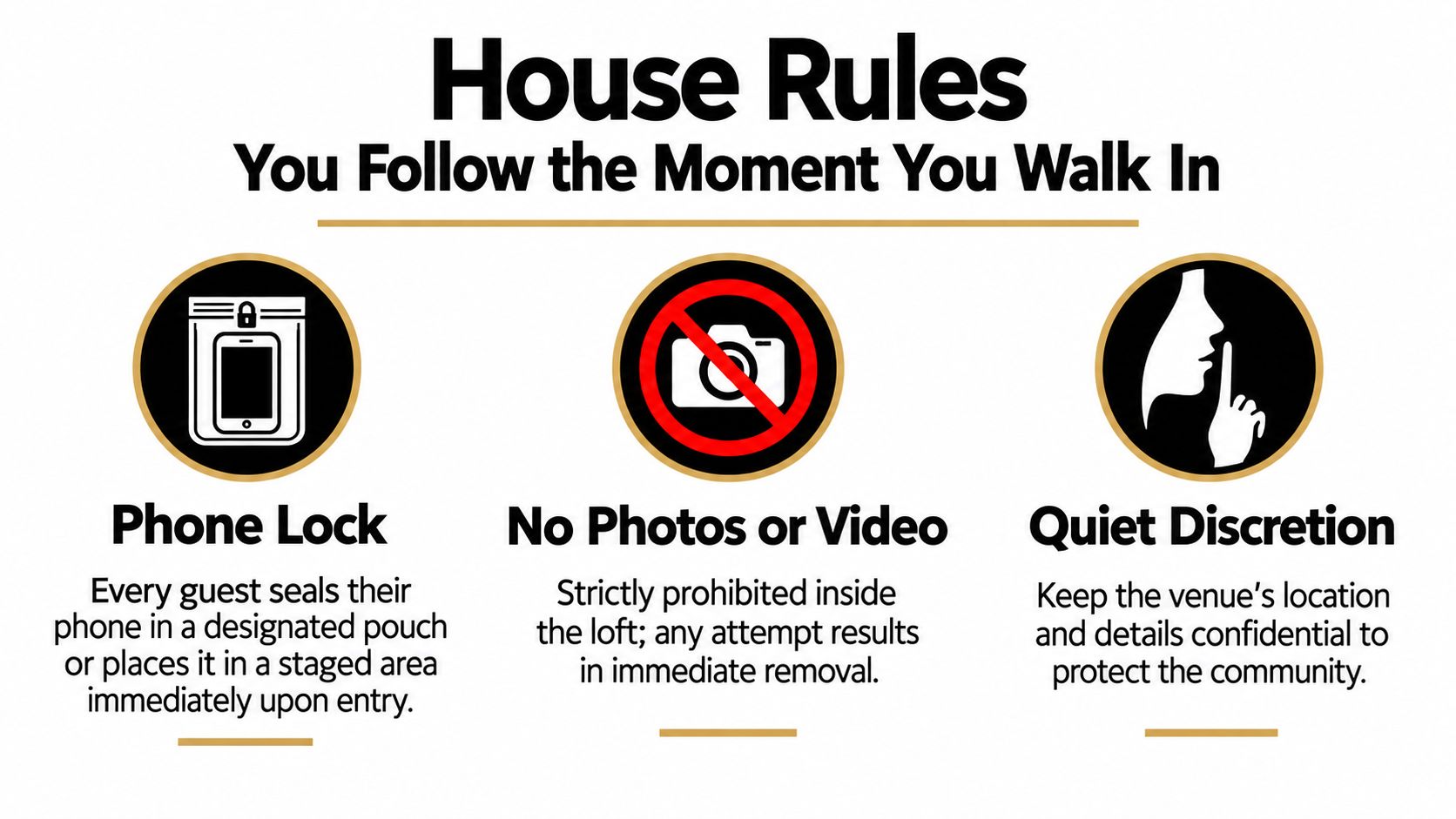
The reason for this structure is simple. Privacy, hygiene, and sobriety affect every other guest, so one person's disregard can change the entire room. A host who waits until a problem becomes dramatic has already allowed the environment to deteriorate.
The practical guide to dance-floor etiquette is useful even in a loft setting because shared space requires awareness. Don't assume that a themed room means everyone wants the same interaction. Check the local expectations, notice how guests respond, and ask a host when you're unsure.
Consent Mechanics and the Role of Hosts on the Floor
Consent becomes meaningful when guests and hosts know what to do in the moment. A general statement about respect isn't enough if nobody can identify the next action after someone hesitates, goes quiet, or changes his mind.
BAREHOUSE states the core mechanics plainly. Ask before touching every time. “Not right now” is a complete answer and doesn't require follow-up questions. If someone freezes, goes quiet, or appears to withdraw, stop and check in verbally. The BAREHOUSE experiences guidance also makes the host's role explicit. Hosts are present to help, and that responsibility belongs to them.
Consent is an ongoing exchange
A yes to one interaction isn't a yes to another. A guest can welcome conversation and decline touch. He can agree to one activity and stop later. He can change his mind without providing a reason that satisfies the other person.
That's why the strongest rule is also the simplest: ask before every touch. Clear communication protects both people from guessing, and it makes it easier for someone to decline without having to manage another guest's disappointment.
Freezing and silence require special attention. Some people don't produce a clear verbal refusal under pressure. Treating stillness or withdrawal as a reason to pause gives the person room to recover his voice and decide what he wants.
Hosts provide real-time accountability
Hosts shouldn't hover over every conversation, but they need to circulate and remain easy to find. Their job includes watching the overall temperature of the room, responding to concerns, and stepping in when a boundary appears uncertain or crossed.
A host may pause an interaction, separate guests, check in privately, or remove someone who ignores the rules. That intervention doesn't require a debate on the floor. The priority is restoring safety and giving the affected guest space to decide what happens next.
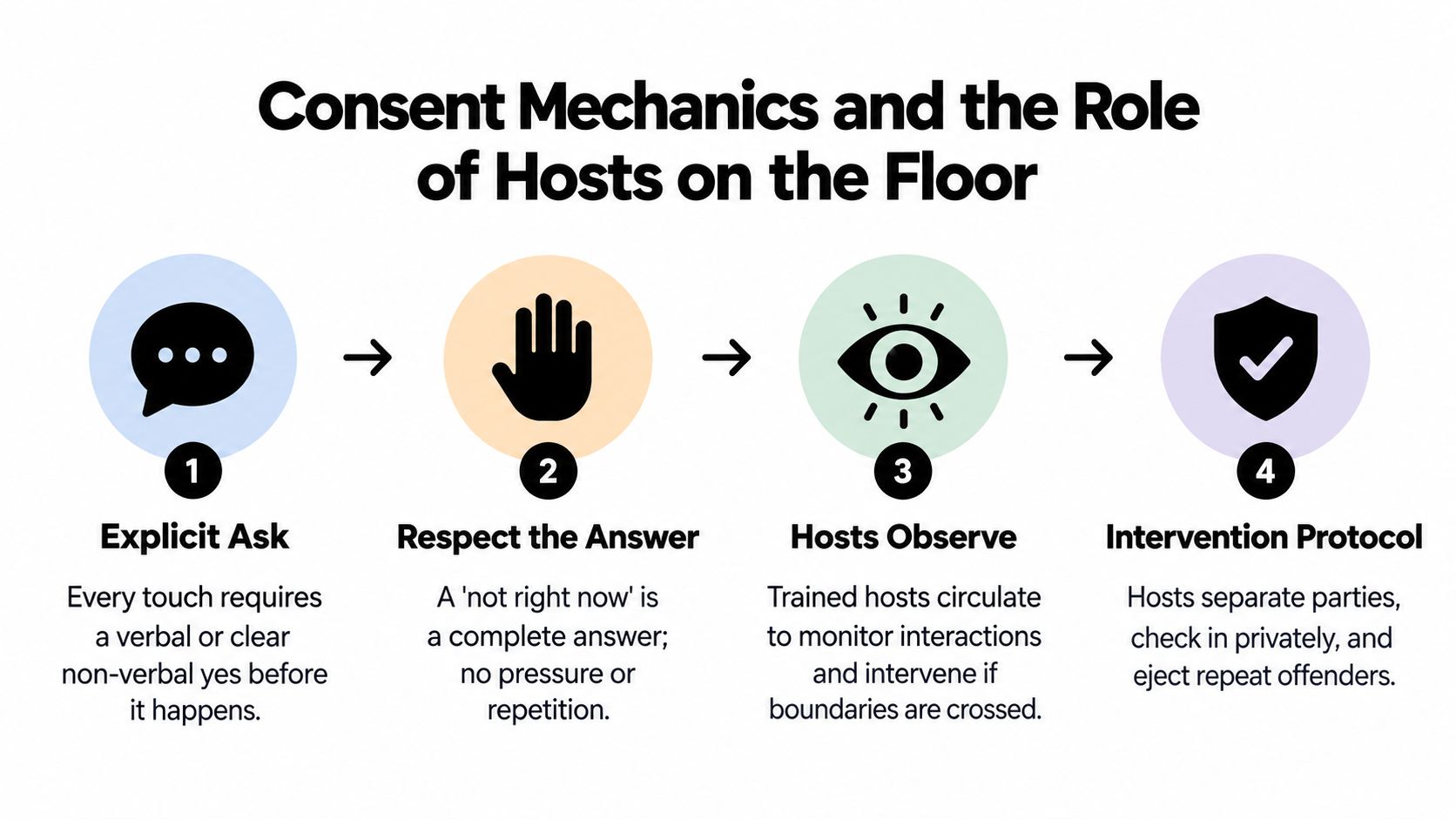
Consent is not a form completed once. It's a series of decisions that can change throughout the night.
This level of structure matters because safety expectations differ across subgroups. NYC research on collective sex venues has highlighted that attendees don't share one uniform view of risk or comfort. An event that assumes otherwise may attract guests successfully and still lose trust at the door or on the floor. Clear rules and visible hosts give people a shared operating language.
A Real Night at a Curated NYC Loft
The night begins before the first room fills. You arrive with the private invitation, confirm your name at the door, and follow the entry process without trying to negotiate around it. Your phone is secured, the host reviews the essential rules, and you learn where to find water, supplies, and staff.

The opening period is usually the easiest time to orient yourself. A host can introduce the general layout, explain which spaces are social or quieter, and point out where to ask for help. You don't need to rush into the center of the room. Starting with conversation or observation is a valid way to find your footing.
As more guests settle in, the event develops separate currents. One room may stay conversational while another becomes more active. Hosts circulate rather than disappearing behind a service counter, which gives guests a visible point of contact without making the night feel supervised in a heavy-handed way.
The pace changes without losing control
Later, the room may become more energetic. Guests who spent the opening period assessing the atmosphere may move into other areas, while others remain in the lounge or choose to leave. The important feature is that the event can shift without abandoning the rules established at entry.
Supplies need attention throughout the night. Water, towels, and other available essentials should remain accessible, and hosts should notice when a room becomes crowded, tense, or difficult to move through. Controlled staffing matters most during these transitions, because unclear boundaries often appear when the energy changes.
The close should be managed with the same care as the arrival. Hosts walk the space, handle final questions, and bring the atmosphere down gradually. Guests leave in small groups rather than turning the doorway into a public scene.
That arc feels different from a bar night because the event isn't asking you to tolerate uncertainty as the price of entry. You know why the address was private, why your device was secured, and who you can approach if something feels wrong. The result isn't guaranteed chemistry. It's a clearer setting in which chemistry can either develop or not develop without the room becoming chaotic.
Evaluating Whether a Private Men's Night Is Right for You
A private men-only event is worth considering when you want more structure than an open RSVP can provide. It may suit a guest who values discretion, a smaller social field, and hosts who can identify everyone in the room. It may not suit someone who wants anonymity, spontaneous entry, or the ability to arrive with friends without prior approval.
Use this checklist before confirming:
- Confirm the format. Is the event invite-only, with a review before the address is shared, or is “private” marketing language for a public ticket page?
- Read the written rules. Check for clear policies covering phones, photography, drugs, hygiene, sobriety, and consent. If the language is vague, ask the organizer for specifics.
- Ask about staffing. You should know how to find a host and whether staff can pause an interaction, remove a guest, or help you leave without pressure.
- Assess the room. Consider the stated theme, layout, neighborhood, and expected intimacy. A smaller space can feel welcoming or intense, depending on what you want.
- Protect your exit. Know how you'll leave, keep control of your transportation, and remember that you can decline an interaction or end your attendance at any point.
- Compare intimacy with anonymity. A private loft offers more control over the guest list. A public bar or large event may offer more anonymity. Choose the trade-off you prefer.
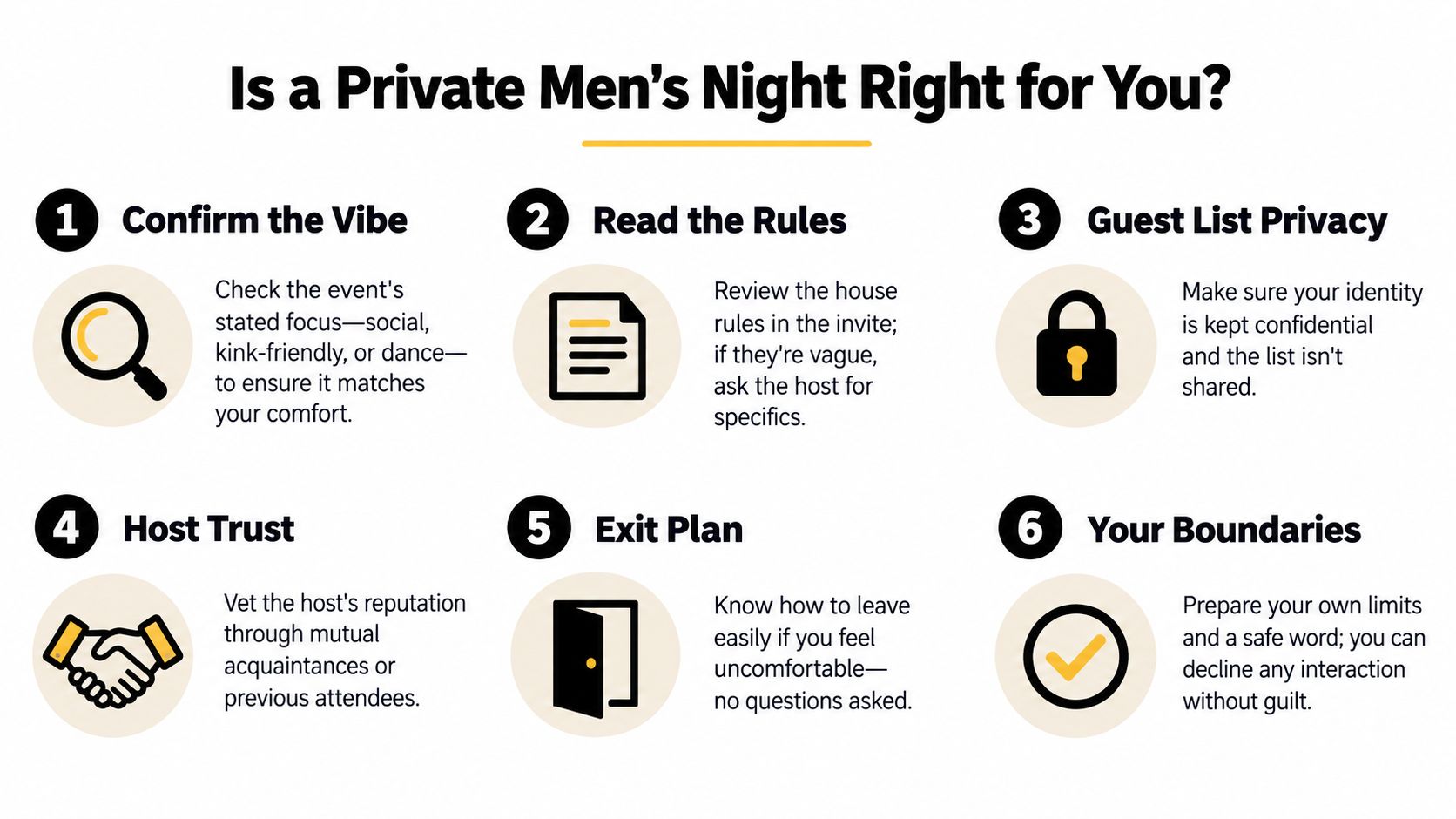
Before accepting an invitation, ask: Who reviews guests? When is the address released? What happens to phones? Are photos prohibited without exceptions? What are the rules around drugs and impairment? Where can you find a host? How are consent concerns handled? What supplies are available, and what should you bring yourself?
For men who are unsure about attending, practical preparation can reduce unnecessary anxiety. These confidence-building tips are most useful when treated as preparation, not performance. You don't need to arrive with a persona or a plan for the entire night. You need to understand the rules, know your limits, and give yourself permission to participate at your own pace.
NYC offers every scale of LGBTQ gathering, from the civic history of Stonewall to the enormous public reach of Pride. A smaller invite-only event serves a different need. If you're searching for a gay event in NYC and the public listings keep missing the experience you want, evaluate the structure before the spectacle.
BAREHOUSE offers invite-only private loft events in New York City for adult gay, bi, and curious men, with guest review, private invitations, phone-free entry, and clearly stated house rules. If that privacy-first format matches what you're looking for, visit BAREHOUSE to learn how the community and invitations work.