First Gay Party What to Expect at a BAREHOUSE Night
You're probably reading this because the invite is sitting in your inbox, or because a friend mentioned a BAREHOUSE night and now you're doing the quiet mental math nobody admits to. You want to know what a first gay party feels like, not the glossy version, and you want the answer straight: what happens, what matters, what doesn't, and how to leave without making a scene if the night isn't yours.
The short version is simple. A BAREHOUSE night is built around privacy, clear rules, and pace, not anonymous chaos. That matters because the first-time anxiety most men carry, the body comparison, the performance dread, the fear of being too quiet, too old, or too visible, tends to fade fastest when the room rewards presence over acting. BAREHOUSE says it runs small, invite-only parties in New York for adult gay, bi, and curious men, and its rules and experiences pages make one thing obvious, this is a phone-free space where consent and reading the room are part of the event itself, not optional extras (about, rules, experiences).
Table of Contents
- The Week Before Your First Night
- Pre-Event Rituals That Actually Help
- Consent, Boundaries, and Reading the Room
- Walking Into a BAREHOUSE Loft
- What If Nothing Goes the Way You Planned
- On-Site Etiquette and a Clean Exit
- After the Night, What Comes Next
The Week Before Your First Night
The seven days before your first BAREHOUSE night can get noisy in your head. You reread the invite, check the time window, picture the loft, and then start negotiating with yourself about whether you belong there, whether you'll know what to do, and whether anyone will notice you're new. That loop is normal, and it usually has a few favorite fears, performance dread, body comparison, being the quietest guy in the room, or worrying you'll be recognized by someone you'd rather not meet in that setting.
What the week actually asks of you
Don't turn the week into a self-improvement project. Treat it like pacing. The point isn't to arrive perfected, it's to arrive regulated enough to stay curious.
There's a practical side to the mental spiral too. Figure out how you're getting home late, make sure you know the address window, and choose one friend you can text when you arrive so somebody outside the room knows you got in cleanly. That's not paranoia. It's just a good habit when you're walking into a private men-only event where the room itself matters as much as whatever happens inside it.
Practical rule: if you spend the whole week trying to imagine every possible outcome, you'll arrive already tired. Better to solve the obvious logistics early and save your energy for the actual night.
A little historical context helps here. Gay bathhouse culture has deep roots, and modern gay bathhouses emerged as discreet, purpose-built venues in periods when homosexual acts were often illegal. That history explains why these spaces, including a night like BAREHOUSE, tend to reward privacy, clear rules, and controlled environments more than raw anonymity (gay bathhouse history). If you've been feeling like the rules are oddly specific, that's because they're designed to make a private space workable.
By the end of the week, the goal is not confidence theater. It's a quieter shift, from imagining the room to preparing one small ritual you can carry into it.
Pre-Event Rituals That Actually Help
The day-of prep should feel boring in the best way. Your body will thank you later for doing less, not more, and for doing it early enough that you're not rushing around while you're already mentally on edge.
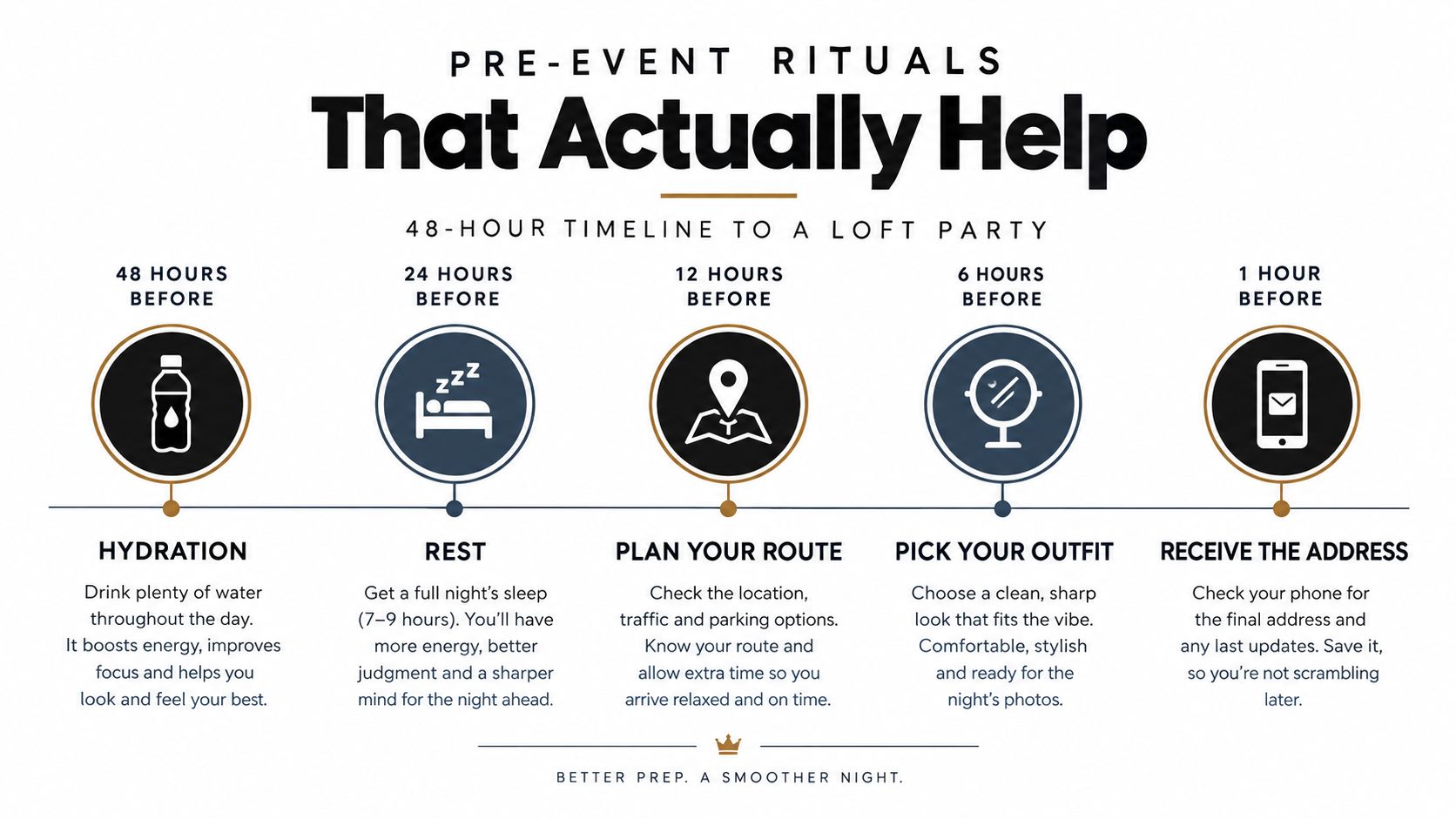
The forty-eight-hour window
Start with sleep. Two nights of real rest beats trying to salvage yourself with caffeine and nerves at 8 p.m. Hydrate starting Thursday if the night is on Friday, because alcohol lands rougher when you're already running dry. Eat a protein-forward meal about two hours before you leave, shower, groom, and keep the whole routine aimed at comfort, not performance.
Then write three lines in your notes app. One line for what you want to feel, one hard boundary, and one easy exit phrase you can use if you need to leave or step away. That kind of writing sounds almost too simple, but it settles the mind because it gives the night a shape before anyone else gets to define it for you.
- What you want to feel: calm, open, social, touched, observed, left alone, whatever is true.
- One hard boundary: no filming, no pressure, no touching without asking, no drugs, no drinks after a certain point.
- One exit phrase: “I'm going to head out,” or “I'm good for tonight.”
The logistics matter too. Lay out your clothes the night before, charge a portable battery for the ride home, and screenshot the address window plus the host contact. If you want a useful confidence refresher before you go, keep these confidence tips from BAREHOUSE handy, not as a pep talk, but as a reminder that steadiness is more useful than swagger.
The best prep lowers the body's alarm response. Once your system stops bracing, your mind gets room to be curious.
That's the point of the rituals. Not to make you impressive, just to make you available to the night instead of already half-defensive.
Consent, Boundaries, and Reading the Room
At a first-time gay sex-party setting, consent has to be active, verbal, and clear. Politeness is not consent. Silence is not consent. Visible intoxication is not consent. If someone looks away, pulls back, freezes, or does not answer, the answer is no, and you move on without turning it into a debate (consent guidance).
The sequence to follow
Ask before touching. Do not join a scene unless you are invited. If someone pulls away, stop immediately. If the room starts to blur because of alcohol, drugs, or nerves, pause and reset instead of trying to improvise your way through it. That is how you keep a private space usable for everyone in it.
BAREHOUSE says the vibe can move from slow and sensual to physical and loud, but consent is required in every space, and guests should watch first, read the room, ask when needed, and never enter someone's scene, pile, table, or group unless they are welcomed (experiences). Read the room before you move into it.
Soft no means no. A freeze means no. A maybe that does not become a yes means no.
A slower room and a more physical one usually feel different in the body. In a slower space, people stand or sit with more distance, conversation carries the room, and the energy stays contained. In a louder space, bodies are closer, movement is more direct, and the room itself tells you to slow down and ask more, not less.
If your own boundary gets fuzzy mid-night, do not sit there arguing with yourself. Step into a quiet corner, take a breath, find a host, and say plainly what is happening. Hosts and staff should be the first people you tell if harassment starts. Safety-focused guidance also warns that filming or sexualized photos without permission can be illegal in some places.
The simple rule is this. Consent and pacing are the same discipline. If you go slowly before you arrive, you are more likely to stay clear once you are inside.
Walking Into a BAREHOUSE Loft
The walk-in is usually quieter than people expect. You get the address by text close to the event, the name is checked, and then you step into a dim loft instead of a club trying to impress you with noise. BAREHOUSE describes itself as a private club for gay and bi men in New York City, and its about page makes the point plainly, the room stays small, curated, and invite-only because who is inside matters as much as what happens there.
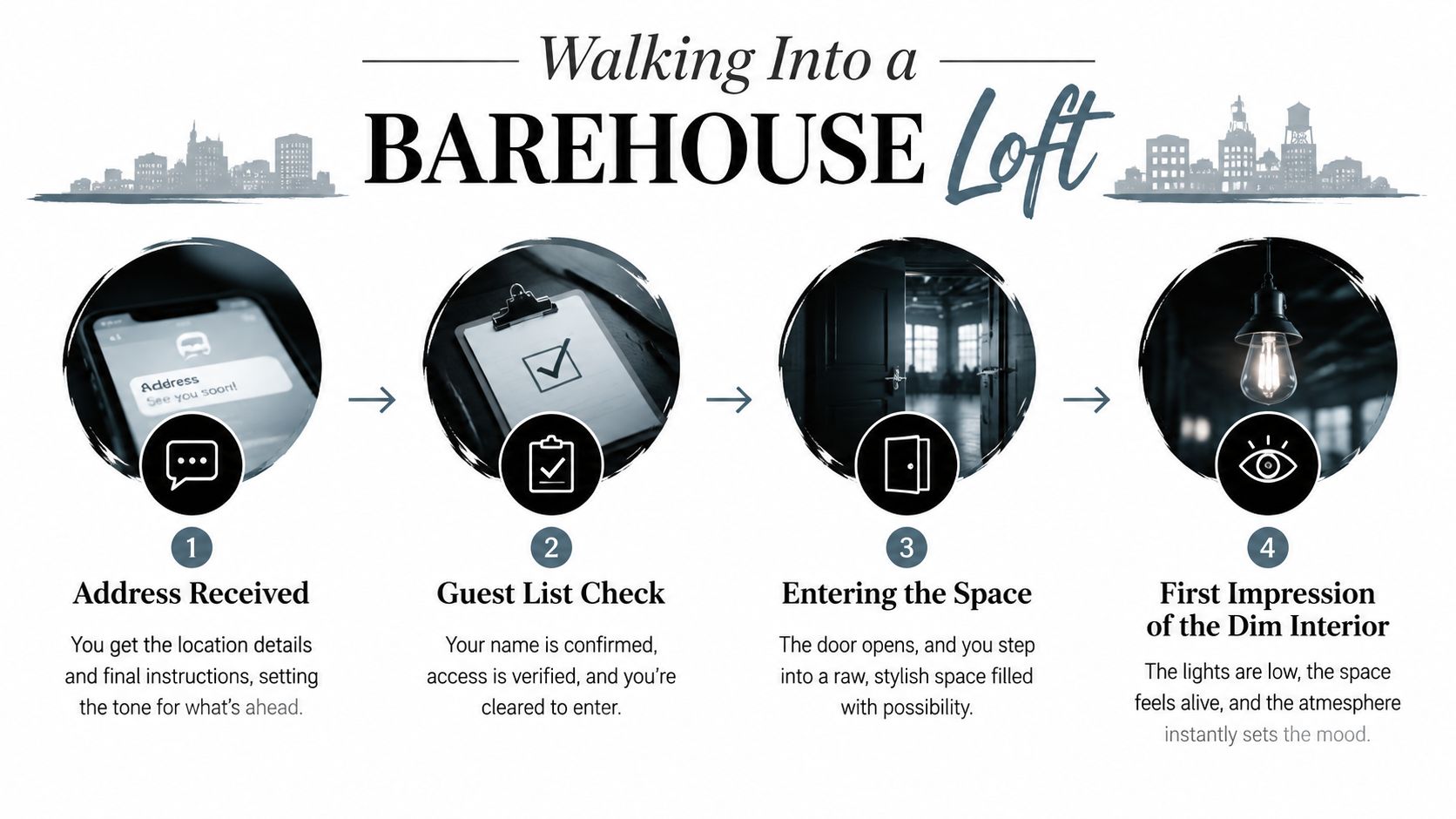
What the first ten minutes feel like
The phone-locking rule is part relief, part reset. BAREHOUSE says phones and cameras are not allowed, devices are locked on arrival, staff enforce the rule without exception, and no photos leave the party. That is privacy, and it also cuts the pressure to perform for an invisible audience.
Start by finding the hosts, locating a quieter corner, and watching before you join anything. If the space includes communal changing or shower-adjacent logistics, treat it like any adult shared setting and keep your attention on your own business. The same common sense behind hygiene tips for fitness centers applies here, especially around shared surfaces and not drifting into other people's space.
The room sets the pace. Some nights stay conversational, others get more physical and direct, and you should not force one energy onto another. Read the room, then choose your own speed.
For a clearer sense of the loft format in New York, this BAREHOUSE loft party overview is worth a look before you go. It will not tell you how the night feels in your body, but it will give you the shape of the space. Enter, clock the hosts, find the edge of the room first, and let the room show you its rhythm before you decide how far in you want to go.
What If Nothing Goes the Way You Planned
A lot of men carry a stupid script into their first party. They think they should perform confidence, hook up, stay until close, and feel constantly aroused. That script is borrowed, and it falls apart quickly once the room stops cooperating.
The night does not need to look dramatic
If you don't get hard, that doesn't mean the night failed. Novelty, alcohol, pressure, and simple nerves can all flatten arousal or scatter it. If you leave after an hour, that still counts as having gone, seen the room, and honored your actual capacity.
Recent first-timer advice aimed at this exact kind of event says not to measure success by cumming, and notes that these nights can be overstimulating (first-time advice). That's the better standard anyway. If your body stays cautious, believe it. If your interest rises and falls, let it. The room is not a test.
Here's the trade-off. If you force yourself to push through because you think a short night looks weak, you usually get more tense, less present, and more self-conscious. If you leave when you're done, you keep your dignity and you learn something useful about your own pacing.
Success is staying aligned with the intention you wrote down, not matching someone else's script for a perfect first night.
Awkwardness happens. Social freezing happens. Seeing other men move with ease can pull you into comparison, and that comparison is usually unfair because you're looking at their surface, not their nerves. Your job is simpler. Stay aligned with the boundary you named before you arrived, and let the rest be data.
On-Site Etiquette and a Clean Exit
Once you're inside, keep your behavior plain and easy to read. If you want conversation, make eye contact, stay in the open, and keep your posture relaxed. If you're not interested, step back a little, keep it brief, and do not make a scene trying to be polite.
How to handle offers and pressure
If someone offers you a drink and you do not want it, decline cleanly. No speech is needed. “No thanks” is enough. If alcohol is part of the night, pace yourself, eat beforehand, and alternate drinks so your judgment stays steady.
BAREHOUSE's house rules and the way its experiences are run are clear about the basics, ask before touching, read the room, and accept that the host team is there to keep the space in order, not to hover (experiences, rules). If something feels off, bring in a host early. That is what they are there for.
If you are used to more openly staffed or security-heavy spaces, tips for managing security guards can help you treat staff as practical support instead of a barrier, even in a more intimate setting.
The clean exit protocol
Leave during a quiet moment, not at the center of attention. Thank the host by name, collect your phone, and go without announcing it to the room. Do not apologize for leaving. Do not stay longer just because you feel you should. Do not turn the doorway into a long debrief.
- Signal less, not more: a nod, a quiet goodbye, a hand on the shoulder if that has already been established.
- Skip the explanation tour: you do not owe the room a reason.
- Protect the space: keep the exit discreet so the next guest gets the same calm environment.
If you want a useful companion note on movement and social flow, BAREHOUSE's dance floor etiquette guide fits this part of the night. The same rule applies in both places, clarity beats performance, and a well-timed exit is part of good etiquette, not a failure of stamina.
After the Night, What Comes Next
The door closes behind you and the adrenaline drops out of your body faster than your thoughts do. That's when the replay loop starts. You'll remember a face, a comment, a choice you made, maybe a moment that felt sharper in the room than it did in real time. The quiet after a private night can feel strange, but it's also where you learn what happened.
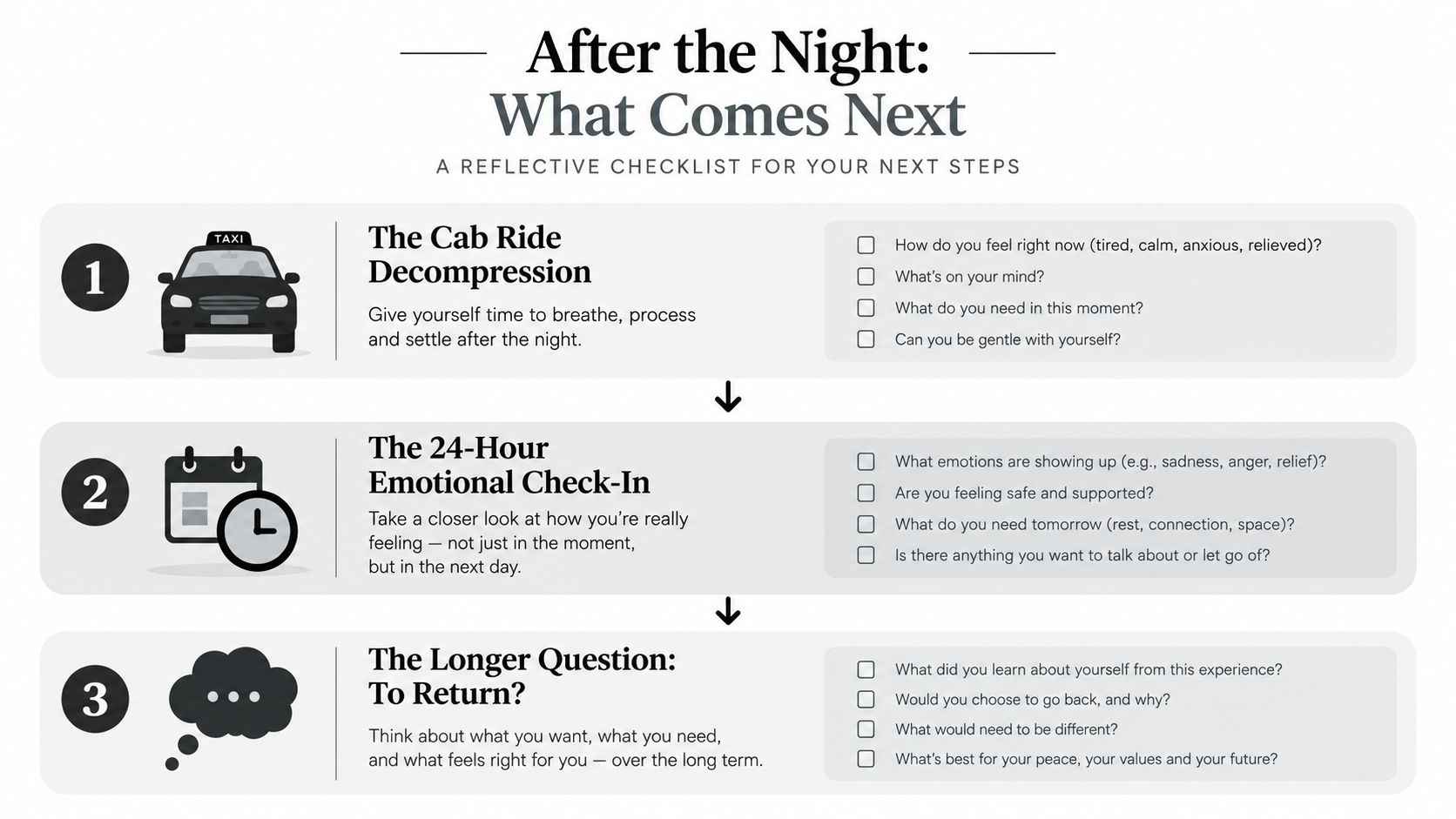
The first hour
Write three lines within an hour of leaving. What felt good. What felt off. What you'd change next time. Keep it plain. This is not a diary entry for posterity, it's a practical note so your memory doesn't rewrite the night according to mood alone.
Then do the obvious aftercare. Hydrate. Wash the phone pouch or any gear that needs it. Launder what you wore. Sleep without screens if you can manage it. Those small acts help your body leave the event behind instead of carrying it all the way into the next morning.
The next day and beyond
The group chat can get noisy with forced enthusiasm. You don't need to match it. If you connected with someone and want to follow up, do it directly and without fuss. If you don't feel like performing excitement, don't. You can have had an interesting night without declaring it life-changing.
The last question is whether you return. You don't have to. A single off night is data, not destiny, and a good first night isn't a promise you need to keep proving. Go back if the room, the rules, and your own appetite line up. Stay home if they don't.
The point of a first gay party isn't to collect a story that sounds impressive. It's to learn how you move through privacy, consent, and pace when nobody is selling you a fantasy. If that sounds like the kind of night you want, visit BAREHOUSE and see how a phone-free, invite-only loft evening for gay, bi, and curious men in New York is set up.